If you have a dental emergency, please call us on 010 – 4361604



 Nederlands
 English
Root canal treatment
During root canal treatment, the inside of the tooth is treated by removing the inflamed or damaged dental pulp from the root canal system.
General information
About the treatment
Teeth consist of a crown and one or more roots. The roots are anchored in the jawbone beneath the gums. Each root contains one or more root canals, which contain nerves and small blood vessels. If the tissue inside the root canal system becomes irreversibly damaged, for example following an injury, or becomes infected, your dentist may recommend root canal treatment.
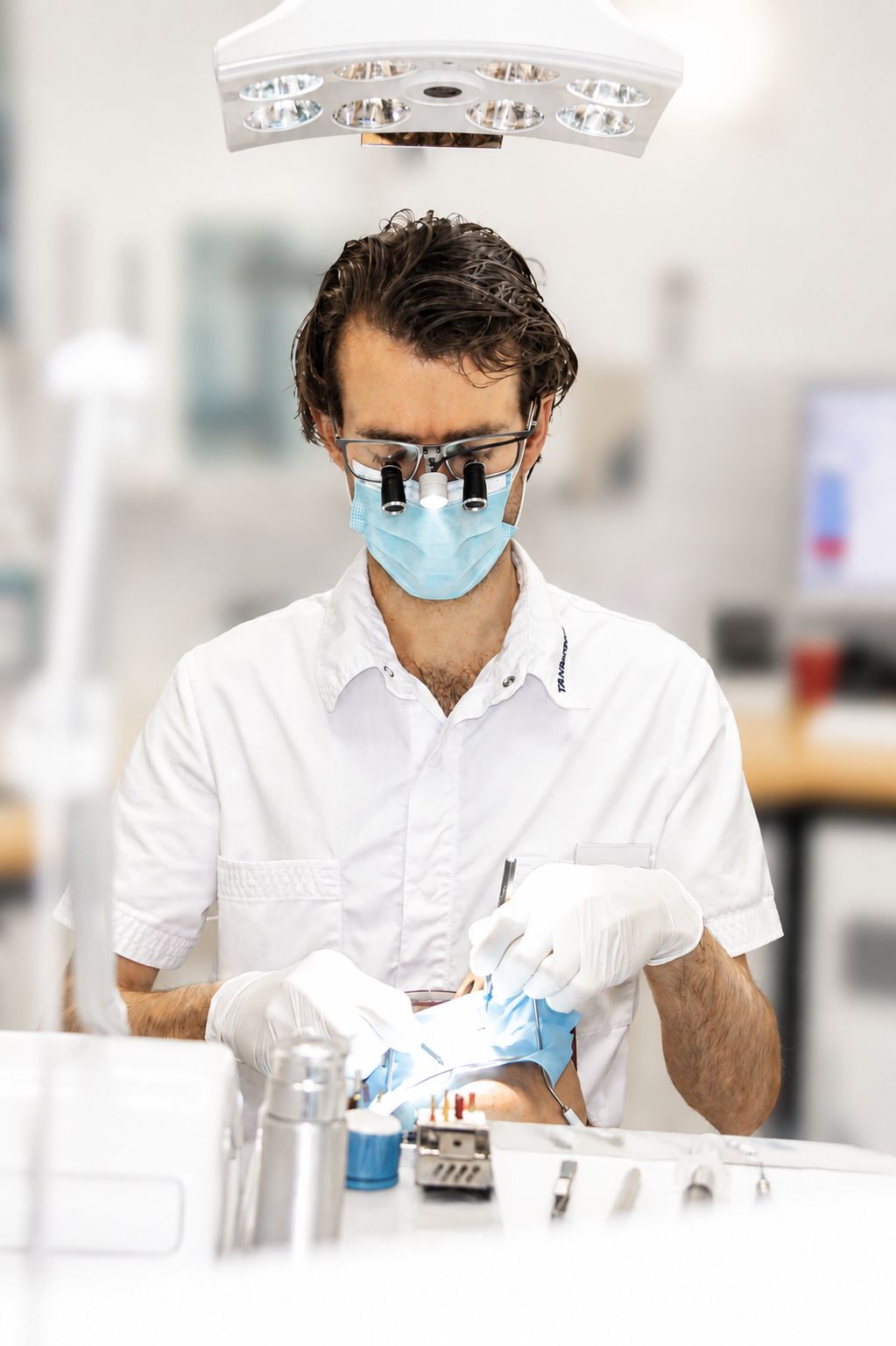
At TANDZORG.NL, we aim to make root canal treatment as comfortable as possible. We therefore use modern techniques and equipment, including a dental operating microscope, ultrasonic cleaning and advanced filling systems.
Before treatment begins, an X-ray is taken to assess the shape and position of the roots. Local anaesthetic is then administered. Your dentist will place a rubber dam, a small sheet of rubber that isolates the tooth and helps maintain a clean and dry treatment area.
An opening is made in the chewing surface of the tooth to access the root canal system. Fine instruments are then used to remove the inflamed or damaged dental pulp and carefully clean and shape the root canals. The canals are thoroughly disinfected before being filled and sealed with a special root canal filling material. The tooth is then restored with a dental filling.
Root canal treatment often requires two appointments. In this case, a temporary filling is placed after the first appointment. At the second appointment, the root canals are permanently filled and the tooth is restored.
Once the tissues around the tooth have had sufficient time to heal, particularly if there was an infection, a partial or full dental crown is often recommended. This helps strengthen the treated tooth and reduces the risk of it fracturing in the future.
Fees
Fees
Treatment fees must be paid at the reception desk immediately after your appointment, preferably by debit card or, if necessary, in cash. This overview is intended as a general indication only. As every patient requires an individual treatment plan, the final costs may vary from person to person.
Our fees are based on the Performance and Tariff Decision for Dental Care issued by the Dutch Healthcare Authority (Nederlandse Zorgautoriteit, NZa), valid from 1 January 2026 to 31 December 2026. For more information about dental costs and reimbursements, please visit allesoverhetgebit.nl.
| Root canal treatment | Treatment code | Fee |
| Comprehensive root canal treatment consultation | E02 | €52,51 |
| Small X-ray | X10 | €21,00 |
| Electronic root canal length determination | E85 | €18,75 |
| Conduction and/or infiltration anaesthesia | A10 | €18,75 |
| Applying rubber dam | C022 | €15,00 |
| Use of an operating microscope during root canal treatment | E86 | €101,27 |
| Filling of the pulp chamber and sealing of the canal orifices | E88 | €75,02 |
| Surcharge for the use of rotary nickel-titanium instruments | E04 | €59,25 |
| Root canal treatment for a tooth with one canal | E13 | €135,03 |
| Root canal treatment for a tooth with two canals | E14 | €195,04 |
| Root canal treatment for a tooth with three canals | E16 | €255,06 |
| Root canal treatment for a tooth with four or more canals | E17 | €315,07 |
| Core build-up with composite material | R31 | €75,02 |
| One-surface composite filling | V91 | €60,01 |
| Two-surface composite filling | V92 | €78,77 |
| Three-surface composite filling | V93 | €93,77 |
| Multi-surface composite filling | V94 | €120,03 |
FAQ
Frequently asked questions
Can’t find the answer to your question? Please feel free to contact us.
No. During root canal treatment, local anaesthetic is used, so you should not feel any pain during the procedure. Once the anaesthetic has worn off, the treated tooth may feel sore or tender for a few days and sometimes up to a week, particularly when biting or chewing.
This is a normal part of the healing process and can usually be managed effectively with standard pain relief.