If you have a dental emergency, please call us on 010 – 4361604


 Nederlands
 English
Dental implant
A dental implant is a small titanium screw that acts as an artificial tooth root and is placed in the jawbone where the root of a missing tooth once was.
General information
About the treatment
Your first appointment will be a consultation. During this visit, your oral health will be assessed and we will determine whether there is sufficient jawbone to place the dental implant. If there is insufficient bone, an additional procedure such as bone grafting may be required. Bone grafting can be carried out using your own bone, bone substitute material or a combination of both, after which the dental implant can be placed.
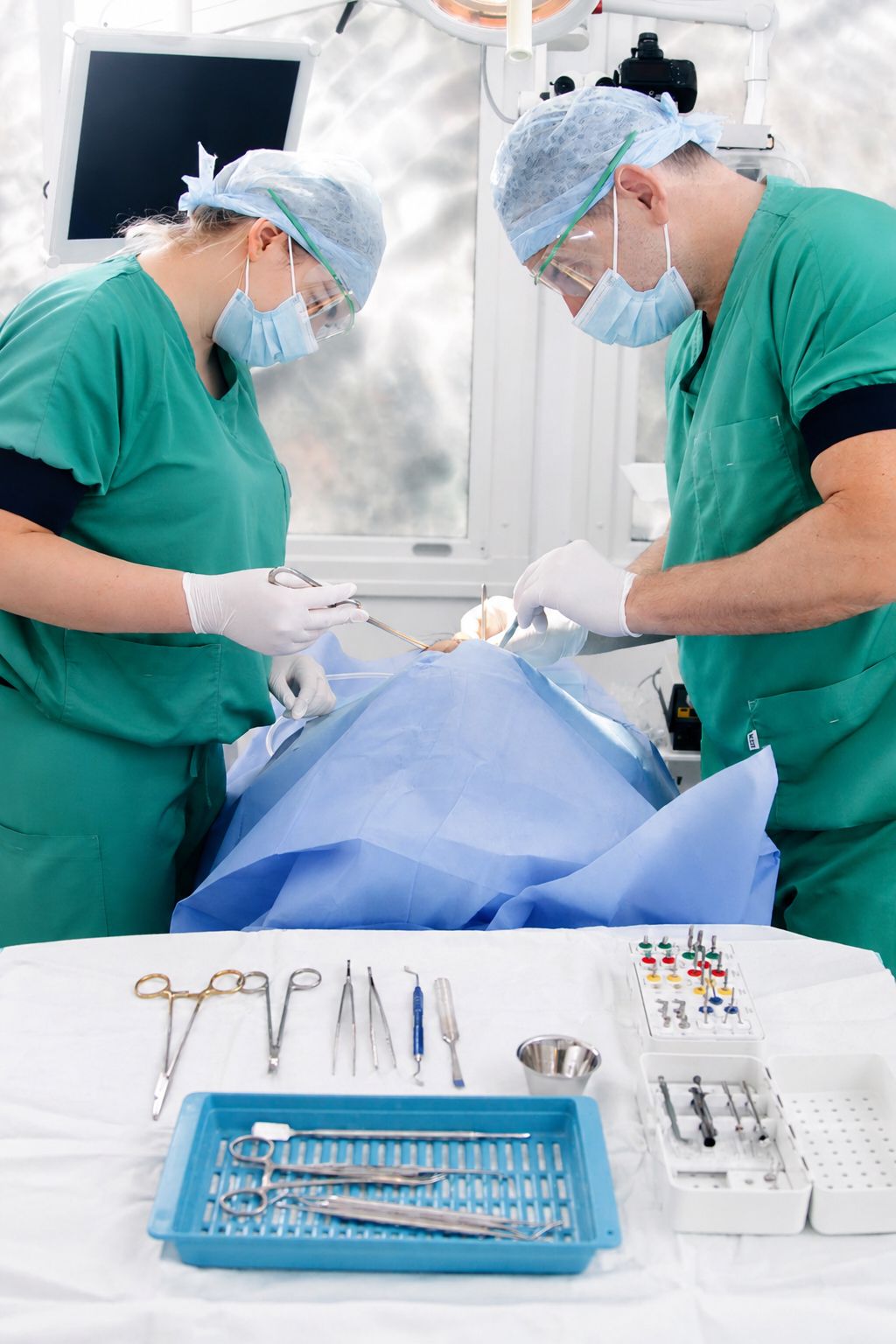
To place the dental implant, a small opening is made in the gum to expose the jawbone. A space is then carefully prepared in the bone to accommodate the dental implant. The dental implant is placed into the jawbone and a cover screw is attached. The gum is then closed with sutures. In many cases, the cover screw is completely covered by the gum during the healing period. The procedure is carried out under local anaesthetic.
Depending on the type and position of the dental implant, it may either remain visible in the mouth or be covered by the gum while it heals. If the dental implant is covered, a small second procedure may be required approximately six weeks to six months later. Under local anaesthetic, the dental implant is exposed and the cover screw is replaced with a healing abutment, which extends through the gum and remains visible.
Once the dental implant has successfully integrated with the jawbone, your dentist can begin making the dental crown or dental bridge.
Regular follow-up care is important after treatment. We generally recommend having the dental implant and the dental crown or dental bridge checked by your dentist approximately twice a year.
Fees
Fees
Surgical treatments carried out at Tandzorg Chirurgie are generally covered by Dutch basic health insurance, unless the treatment is considered cosmetic.
BASIC HEALTH INSURANCE
Everyone who lives or works in the Netherlands is legally required to have basic health insurance. This covers standard healthcare, including care provided by GPs and medical specialists.
Oral surgery at TANDZORG CHIRURGIE is classified as medical specialist care and therefore falls under hospital care. Our oral surgeon provides treatments that are covered by basic health insurance, also referred to as insured care.
For insured care, you will need a referral from your dentist, GP or medical specialist. Please be aware that the statutory excess, any voluntary excess and, where applicable, a personal contribution may still apply.
EXAMPLES OF INSURED CARE
- Extraction of teeth
- Surgical removal of wisdom teeth (third molars)
- Apicectomy (treatment of an infected root tip)
- Consultations
- Removal of cysts or foreign bodies
- Diagnosis and treatment of oral mucosal conditions, including biopsy
- Orthodontic surgery where surgery is required as part of orthodontic treatment
- Diagnostic X-rays
TANDZORG CHIRURGIE also provides treatments that are not normally covered by basic health insurance. These are referred to as non-insured care.
If there is a medical indication for such treatment, prior authorisation may be requested from your health insurance provider. If approval is granted, the treatment may be partially or fully covered by basic health insurance.
EXAMPLES OF NON-INSURED CARE
- Dental implant treatment
- Pre-implant surgery, such as bone grafting
- Periodontal surgery
- Surgical exposure of dental implants
- Cosmetic gum surgery
FAQ
Frequently asked questions
Can’t find the answer to your question? Please feel free to contact us.
Dental implants may be considered when one or more natural teeth, including their roots, are missing. This may be the case following an accident, infection, or when a partial or full denture no longer fits securely.
Together with your dentist, you can discuss whether dental implants are a suitable option for you. Sufficient jawbone height and width are required to place a dental implant safely. Your dentist will assess this, for example by using X-rays.
If there is not enough jawbone, dental implants may not be placed immediately. However, this does not necessarily mean that implant treatment is not possible. In some cases, bone grafting can be carried out first, either at the same time as implant placement or as a separate procedure.
When there is sufficient jawbone of good quality, dental implants have a very high success rate, particularly in the lower jaw, with success rates of over 95%.
If bone grafting is required because there is insufficient jawbone, the success rate may be slightly lower. Smoking can also reduce the chances of successful implant treatment and may affect healing.
Most dental implants are cylindrical or screw-shaped and are made of titanium. Titanium is highly biocompatible, meaning that it is generally well tolerated by the body and allows the jawbone to grow directly onto the implant surface. This process is known as osseointegration.
Many dental implants have a specially roughened surface to encourage bone growth around the implant and help it become securely integrated with the jawbone.
The length and diameter of the dental implant are selected according to the amount of available jawbone and the tooth that needs to be replaced. For example, a front tooth may require a narrower implant, while a molar generally requires a wider implant. If the jawbone is not wide enough, bone grafting may be considered to create sufficient space.
Dental implants generally range from approximately 3 to 6 mm in diameter and 6 to 16 mm in length. Your implant dentist or oral and maxillofacial surgeon will select the most suitable implant based on the shape and quality of your jawbone and the type of dental crown, dental bridge or denture that will be placed.
After the dental implant has been placed in the jawbone, it needs time to integrate with the surrounding bone. This healing period usually takes between 6 weeks and 6 months, depending on factors such as the quality of the jawbone. Your dentist or oral and maxillofacial surgeon will advise you on the appropriate healing time.
Once the dental implant has successfully integrated with the jawbone, a dental crown, dental bridge or denture can be fitted onto the implant.