If you have a dental emergency, please call us on 010 – 4361604


 Nederlands
 English
Dental care for children
At TANDZORG.NL, we believe in caring for your child’s oral health from an early age and working closely with parents and carers to help keep their teeth and gums healthy as they grow.
General information
About the treatment
Our structured approach is designed to promote good oral health and help children become more comfortable with dental care. After all, healthy primary teeth provide an important foundation for the permanent teeth.
FIRST DENTAL CHECK-UP
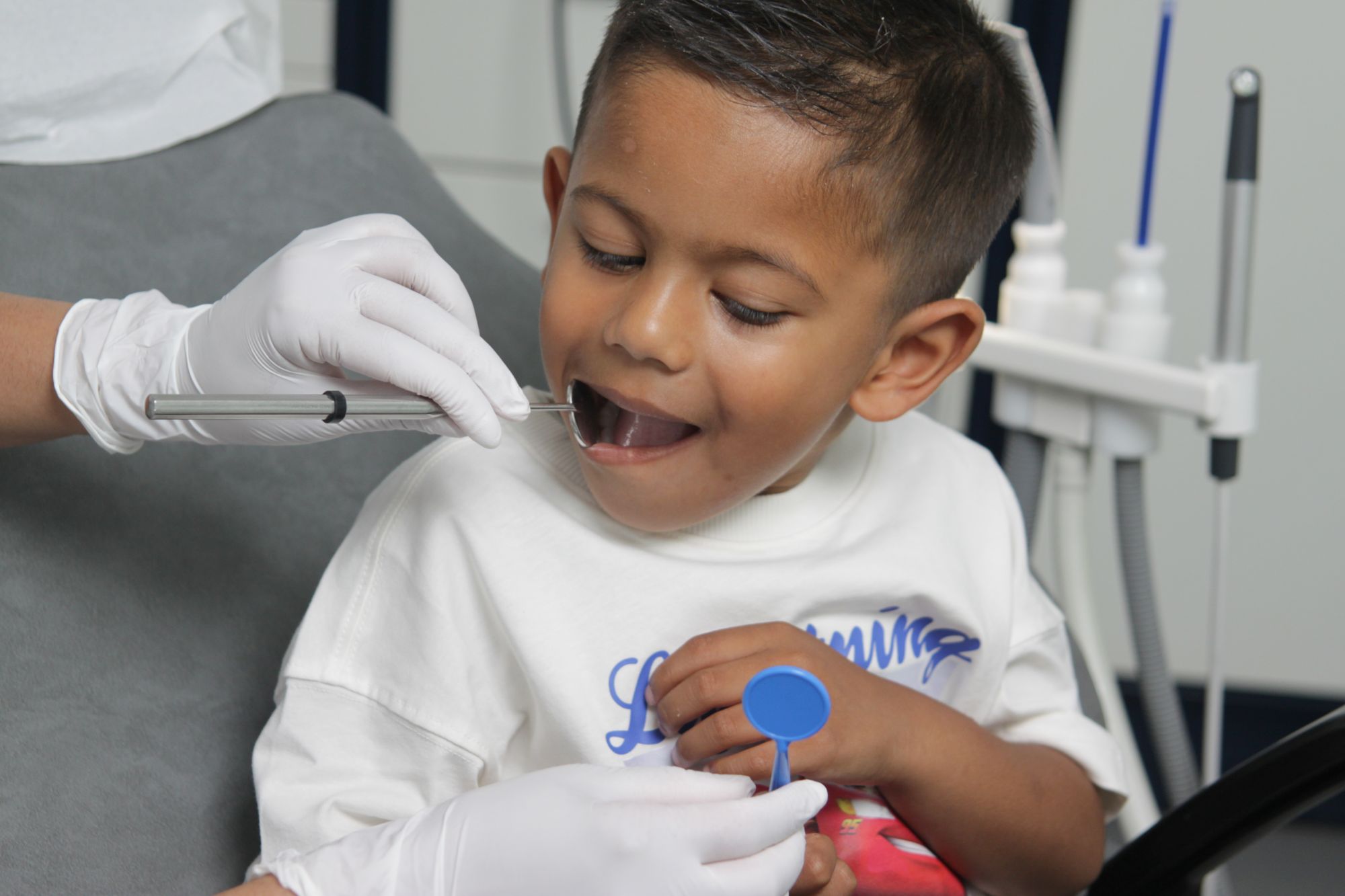
Your child can start visiting the dentist or dental hygienist from around six months of age, or as soon as the first primary teeth begin to appear. The main purpose of this first visit is to help your child become familiar with the dental environment in a relaxed and positive way. We will also carry out a simple examination of your child’s mouth and count the teeth that have come through. Click here for more information.
If you have any concerns or if your child has a dental problem or accident, you are of course welcome to contact us sooner to arrange an appointment.
To help prevent dental problems such as tooth decay and gum inflammation, we follow the Gewoon Gaaf preventive care programme developed by the Ivoren Kruis. This programme focuses on healthy eating habits and effective toothbrushing for children from birth up to the age of 18.
The advice and guidance we provide are tailored specifically to your child and to you as their parent or carer. How often we recommend seeing your child depends on their individual risk of developing tooth decay. We will discuss the most suitable recall interval with you.
Fees
Fees
The most commonly used treatment codes for children’s dental care.
Treatment fees must be paid at the reception desk immediately after your appointment, preferably by debit card or, if necessary, in cash. This overview is intended as a general indication only. As every patient requires an individual treatment plan, the final costs may vary from person to person.
Our fees are based on the Performance and Tariff Decision for Dental Care issued by the Dutch Healthcare Authority (Nederlandse Zorgautoriteit, NZa), valid from 1 January 2026 to 31 December 2026. For more information about dental costs and reimbursements, please visit allesoverhetgebit.nl.
| Dental care for children | Treatment code | Fee |
| Periodic dental check-up | C002 | €28,51 |
| Consultation other than periodic check-up | C003 | €28,51 |
| Written medical history | C010 | €28,51 |
| Small X-ray | X10 | €21,00 |
| Non-resorative treatment of caries in the primary dentition | M05 | €33,76 |
FAQ
Frequently asked questions
Can’t find the answer to your question? Please feel free to contact us.
Start brushing your child’s teeth as soon as the first tooth comes through. Use a soft toothbrush with a small head that is suitable for children. When brushing, make sure your child’s head is well supported. You can stand behind your child, or lay a younger child down on a bed or sofa. Brush in a systematic way, following the curve of the teeth, and make sure you also clean carefully along the gum line.
Allowing children to brush their own teeth helps them develop independence. Encourage them to practise and gradually take more responsibility for their own oral care. However, parents or carers should continue to brush or supervise brushing at least once a day until the age of 10.
Tooth Decay in Primary Teeth
If tooth decay develops in a primary tooth, we aim to treat it in the most child-friendly way possible. In the early stages, we may carefully reshape the affected area, a technique sometimes referred to as slicing. This makes the area easier to reach with a toothbrush. By brushing these areas thoroughly with fluoride toothpaste, together with your child, the progression of the decay can often be slowed down significantly. Local anaesthetic is usually not required for this procedure, which can make the treatment easier for your child to accept.
Slicing can often be completed in a single appointment. If your child finds the treatment difficult, it can also be carried out gradually over several appointments. In addition to treatment, we will show you and your child how to reduce the activity of tooth decay through effective daily oral care. This can help prevent the need for restorative treatment once the permanent teeth have come through.
If there is a significant risk of pain or infection, we may recommend placing a filling in the affected primary tooth.
Tooth Decay in Permanent Teeth
Early signs of tooth decay in permanent teeth are often managed by improving daily oral care and preventive measures. If a tooth is at risk of developing a cavity, a fissure sealant may sometimes be applied to help protect it. If a cavity does develop despite these preventive measures, we will restore the tooth with a tooth-coloured filling.
Fluoride is a naturally occurring mineral that is commonly found in toothpaste. It helps strengthen the teeth and makes them more resistant to acid attacks caused by bacteria, thereby helping to prevent tooth decay.
The recommended use of fluoride is based on the Basic Fluoride Advice issued by the Ivoren Kruis. In summary:
0–1 year (from the eruption of the first tooth): Brush once a day with fluoride toothpaste suitable for young children.
2–4 years: Brush twice a day with fluoride toothpaste suitable for young children.
5 years and over: Brush twice a day with fluoride toothpaste for adults. Toothpastes labelled ‘children’s’ or ‘junior’ may also be suitable. Always check the recommended age range on the packaging.
If you are unsure which toothpaste is most suitable for your child, please ask your dentist or dental hygienist for advice.
In addition to daily brushing with fluoride toothpaste, your dentist or dental hygienist may recommend a professional fluoride treatment if your child is at increased risk of developing tooth decay.
Please note: Additional fluoride products should only be used on the advice of your dentist or dental hygienist.
For more information about fluoride, click here.